ALL ABOUT YEW
Ancient trees, churchyard mysteries and life-saving medicine
From the extraordinary grove at Kingley Vale to Westbourne's centuries-old avenue, the yew is woven into the landscape and history of the Chichester area.
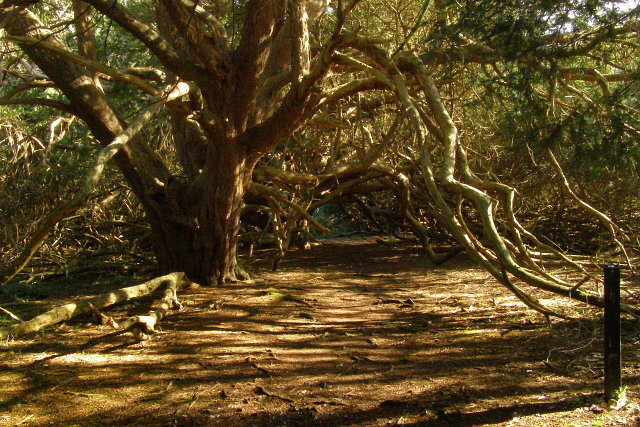
Step into the ancient yew grove at Kingley Vale and the modern world seems to fall away. Beneath the dense evergreen canopy stand great twisted trees, their trunks hollowed, folded and fused into extraordinary shapes.
Some are believed to have been growing here for many centuries, and popular estimates suggest that the oldest could be as much as 2,000 years old. However, dating ancient yews is notoriously difficult because their trunks become hollow and lose the growth rings that would normally reveal their age.
Kingley Vale National Nature Reserve, a few miles north-west of Chichester, contains one of the finest ancient yew forests in Western Europe. Its trees are among the oldest living things in Britain - and they are not the only remarkable yews to be found in our area.
An extraordinary avenue
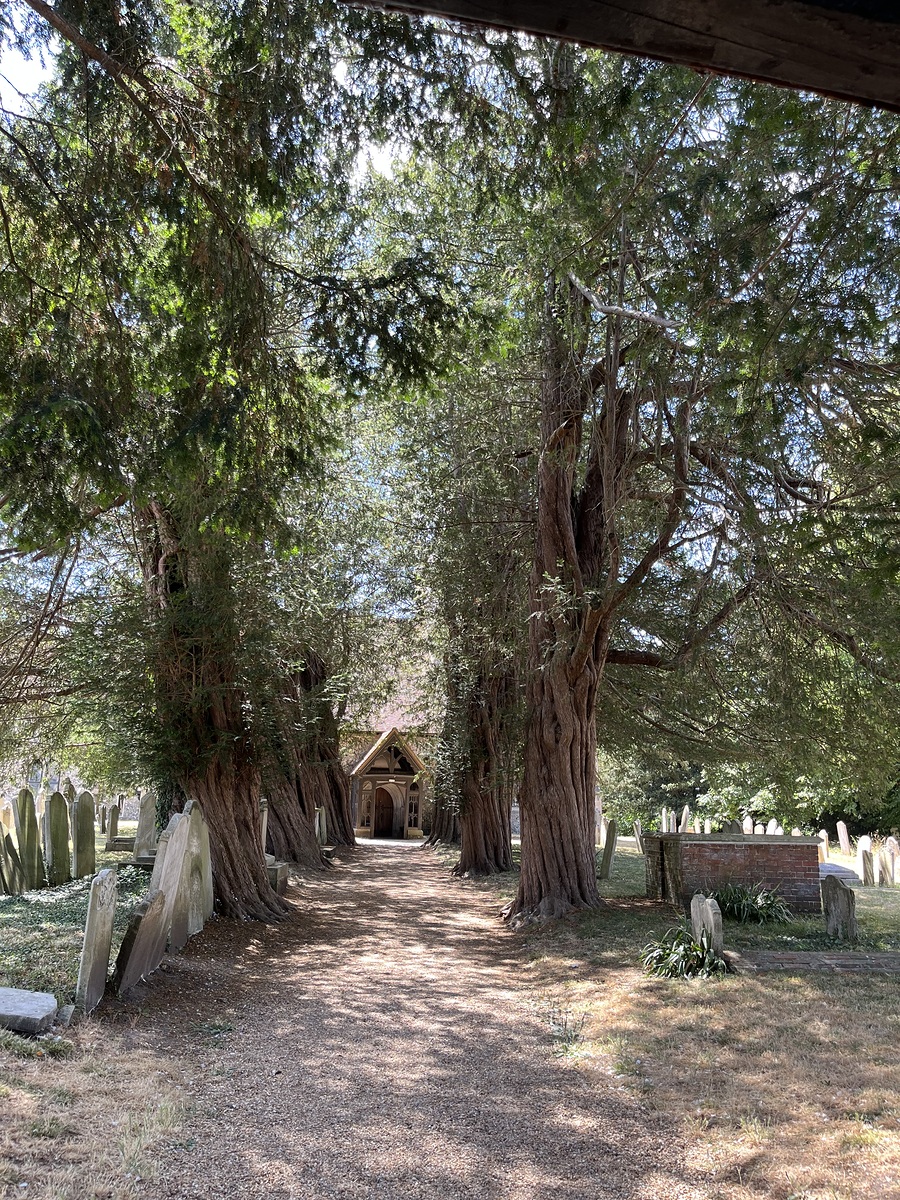
At St John the Baptist Church in Westbourne, visitors approach the church beneath a magnificent avenue of clipped yew trees. The avenue is thought to date from around 1500 and is described by the church as the finest and oldest in England.
An 1848 account recorded an avenue of eight yews 'remarkable for their size', while later histories attributed their planting to the Earl of Arundel. The precise date varies from one account to another, but there is little doubt that these remarkable trees have formed part of the approach to the church for hundreds of years.
Kingley Vale's trees appear wild, ancient and mysterious; Westbourne's have been carefully shaped by generations of human hands. Together, they illustrate two very different sides of the yew's long relationship with people.
Why are yews found in churchyards?
Across Britain, yew trees and churchyards seem to belong together. In some cases, the tree is considerably older than the church standing beside it.
There is no single, proven explanation for this connection. Instead, history, religion, folklore and practical necessity have become intertwined.
Yews were probably regarded as sacred long before Christianity reached Britain. Their evergreen foliage and extraordinary longevity made them natural symbols of endurance, regeneration and everlasting life. When churches were later established on places that were already important to local communities, some ancient trees may simply have remained.
The yew was equally suited to Christian symbolism. Remaining green throughout the winter, it represented eternal life and the promise of resurrection. Its branches were also sometimes used in Palm Sunday ceremonies where palms were unavailable.
There may have been practical reasons too. Almost every part of the yew is poisonous, particularly to livestock, so the enclosed churchyard offered somewhere it could grow away from grazing animals. Its dense foliage could also provide shelter and its roots help bind the soil.
Then there is the longbow theory. Yew wood is strong, flexible and particularly well suited to making bows. It is often said that yews were planted in churchyards to provide wood for English longbowmen. It is an appealing story, but historians question whether churchyard trees would have supplied enough suitably straight timber. Much of the yew used for medieval longbows was imported from continental Europe.
The real explanation is probably a mixture of sacred tradition, symbolism and practicality rather than one simple reason.
A tree of death - and renewal
The yew has always contained a striking contradiction. It is highly poisonous, yet it can live for an immense length of time. Old trees may become hollow, split apart or appear to decay, while continuing to produce new growth.
Branches can reach the ground and take root, while new stems sometimes grow within the hollow centre of an ancient trunk. This unusual ability to renew itself helped create the belief that the yew was almost immortal.
Its dark foliage and association with burial grounds made it a symbol of death and mourning, but its enduring greenery made it a symbol of life beyond death. Few trees embody both ideas so powerfully.
Its red, berry-like fruits add to the contradiction. The soft red flesh is the only part that is not itself poisonous, but the seed inside is toxic. For people - and especially for children - the safest rule is never to eat any part of a yew tree.
From ancient poison to modern medicine
Perhaps the most surprising chapter in the story of the yew began in the 20th century.
During a programme to search plants for possible anti-cancer compounds, researchers studied the bark of the Pacific yew, a species native to North America. They isolated a substance that became known as paclitaxel, or Taxol.
Paclitaxel works by interfering with the ability of cancer cells to divide. It has become an important chemotherapy drug used in the treatment of several cancers, including breast, ovarian and lung cancer.
The discovery initially created a serious problem: obtaining relatively small quantities of the drug required the bark of large numbers of slow-growing Pacific yews, killing the trees in the process. Scientists subsequently developed more sustainable methods of production. These include using compounds obtained from the renewable needles of other yew species, including the European yew, to make the medicine.
This does not mean that the yew can be used as a natural remedy. The raw tree is extremely poisonous and should never be consumed or used in home treatments. Its medicinal value comes from carefully isolated and controlled pharmaceutical compounds.
Walking for wellbeing
A visit to Kingley Vale offers more than a glimpse of the distant past. Walking through woodland and across the open chalk downs can be good for physical and mental wellbeing - providing exercise, fresh air and time away from everyday distractions.
There is something especially calming about walking among ancient trees. The shaded paths, muted sounds and deep green canopy encourage a slower pace, while the climb onto the downs opens up far-reaching views across the surrounding countryside and towards the coast.
Kingley Vale's terrain can be steep and uneven in places, so visitors should choose a walk suited to their ability and wear appropriate footwear. Even without completing the longer climb, spending time quietly among the trees can make a visit feel restorative.
Living links with the past
The yews of Kingley Vale and Westbourne have witnessed centuries of change. One group has survived in an ancient woodland; the other has been tended and shaped beside a village church.
Both invite us to look at time differently. A human lifetime is brief beside a tree that has stood for hundreds - perhaps even thousands - of years.
Once revered as a symbol of immortality, feared for its poison and valued for its wood, the yew continues to surprise us. Today, this ancient tree has another powerful association with life: compounds found within it have helped create medicines used to treat people around the world.